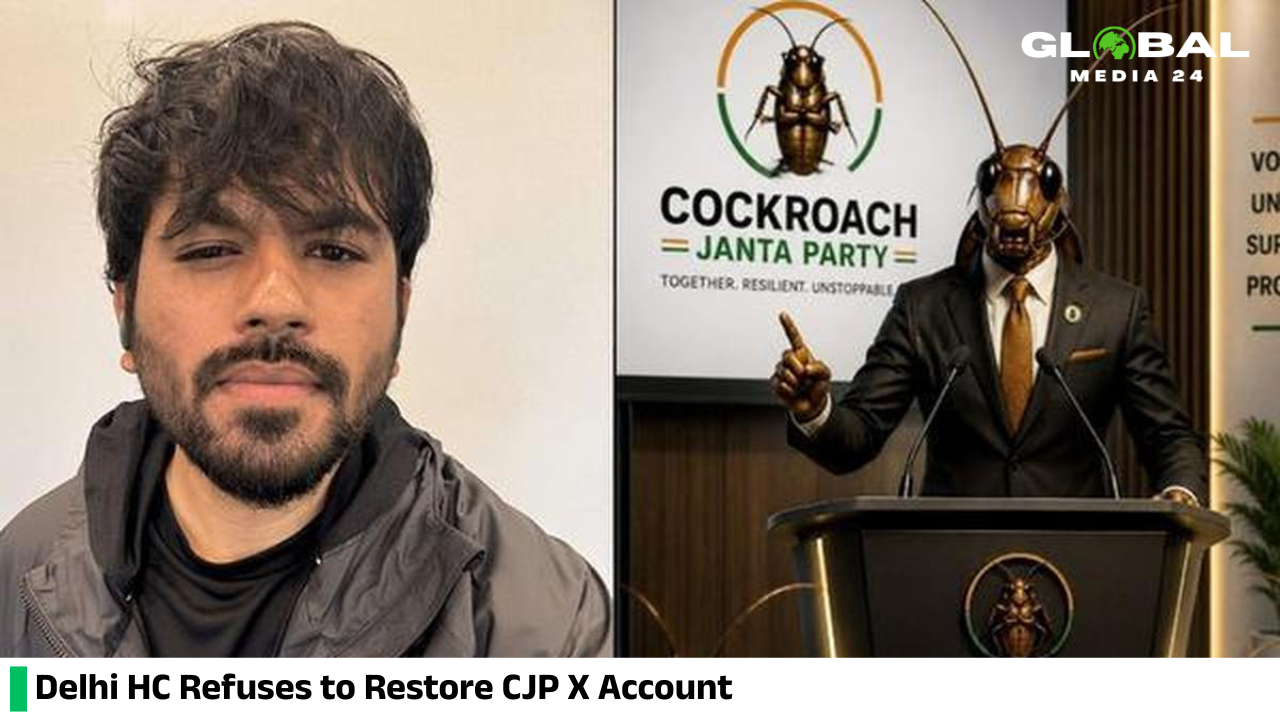
Delhi HC declines immediate restoration of Cockroach Janta Party’s X account in India after blocking action under IT Rules. Justice Purushaindra Kumar Kaurav directs review committee process as legal battle over social media restrictions intensifies.
The Delhi High Court on Friday refused to grant immediate relief to the Cockroach Janta Party (CJP) and its founder Abhijeet Dipke after the party’s X (formerly Twitter) account was blocked in India on national security grounds. The decision has triggered widespread political debate and raised fresh questions about freedom of speech, digital censorship, and the growing role of social media in Indian politics.
Justice Purushaindra Kumar Kaurav observed that the matter involved serious national implications and therefore could not be decided without hearing the Centre’s position. The court issued a notice to the central government and scheduled the next hearing for July 6, while also directing the petitioner to approach the review committee established under the Information Technology Rules.
The case has quickly become one of the most discussed political and legal developments online, especially among young voters and digital activists who closely follow social media-based political campaigns.
Why Was the CJP X Account Blocked?
The original X account of the Cockroach Janta Party was withheld in India on May 21. Authorities reportedly blocked the account citing national security concerns, although the detailed reasons behind the action have not yet been made public.
Following the restriction, the group launched a new account titled “Cockroach is Back,” continuing its online campaign against the government. The move immediately attracted attention across social media platforms, with supporters claiming that the ban was an attempt to silence criticism.
The Cockroach Janta Party was officially launched on May 16 and describes itself as an independent youth-driven political movement focused on raising issues affecting students, young professionals, and ordinary citizens. Within a short period, the group gained traction online through aggressive digital campaigns and anti-establishment messaging.
Court Says Government Must Be Heard First
During the hearing, the Delhi High Court made it clear that the issue could not be decided in haste because it involved “far-reaching consequences.” Justice Kaurav stated that the government must first be given an opportunity to explain the reasons behind the blocking order before any relief could be granted.
The court also pointed out that the review committee under the IT Rules has the authority to examine whether the blocking order complies with the law. The bench allowed Abhijeet Dipke to appear virtually before the committee because he is currently abroad.
The court observed that if the committee concludes that the blocking order was unlawful or unnecessary, it can direct authorities to restore the account.
This legal process is now expected to become a key test case regarding how online political speech is regulated in India.
Growing Debate Over Digital Freedom in India
The blocking of the CJP account has intensified conversations around digital freedom and the power of governments to regulate online content.
Critics argue that social media has become one of the most important democratic spaces for political discussion, especially for smaller organizations and independent movements that may not receive mainstream media attention. According to digital rights activists, sudden blocking actions without detailed public explanation can create fears about censorship.
Supporters of stricter regulation, however, argue that governments must have the authority to act quickly when content is believed to threaten public order or national security.
This case has therefore become larger than just one political party or one social media account. It now touches broader issues involving free expression, government oversight, and internet governance in the world’s largest democracy.
CJP’s Campaign Against NEET-UG 2026 Controversy
One of the biggest reasons behind the rapid rise of the Cockroach Janta Party online has been its aggressive campaign surrounding the NEET-UG 2026 controversy.
The group recently demanded the resignation of Union Education Minister Dharmendra Pradhan over alleged systemic failures in the education system and accusations regarding the NEET-UG 2026 paper leak.
The issue has already sparked protests among students and parents across multiple states. Opposition parties and student organizations have accused authorities of failing to maintain transparency and fairness in one of India’s most important entrance examinations.
CJP used social media heavily to amplify these concerns, posting videos, graphics, and campaign messages targeting the government’s handling of the situation. Political observers believe this campaign significantly increased the party’s online visibility before the account suspension.
Who Is Abhijeet Dipke?
Abhijeet Dipke, founder of the Cockroach Janta Party, was previously associated with the Aam Aadmi Party (AAP). He entered national discussion after launching the new political platform amid controversy surrounding remarks allegedly made by Chief Justice of India Surya Kant during a court hearing.
The term “cockroach” became politically sensitive after comments reportedly referring to “cockroaches” and “parasites” surfaced during discussions linked to a plea regarding senior designation for a lawyer.
Dipke later adopted the word as part of the political identity of the new party, arguing that the movement represents ordinary citizens who feel ignored or dismissed by powerful institutions.
The unconventional name immediately drew attention online and helped the party trend across digital platforms within days of its launch.
Social Media’s Expanding Role in Indian Politics
The CJP controversy once again highlights how political communication in India is rapidly shifting toward social media platforms.
Over the last decade, platforms such as X, YouTube, Instagram, and Facebook have become major tools for political outreach, campaign management, and public mobilization. Smaller political groups increasingly depend on digital platforms because they provide direct access to voters without requiring massive financial resources.
However, this dependence also creates vulnerabilities. When accounts are restricted or blocked, movements can lose their primary communication channels almost instantly.
Experts say the Delhi High Court’s eventual ruling could influence future disputes involving online political speech and government regulation of digital platforms.
What Happens Next?
The next hearing in the case is scheduled for July 6. Before that, the review committee under the IT Rules is expected to examine the legality of the blocking order and submit its findings.
If the committee concludes that the account suspension violated legal standards, authorities may be directed to restore the original X handle. If not, the matter could escalate into a larger constitutional debate over freedom of expression and internet regulation.
For now, the Cockroach Janta Party continues operating through alternative social media accounts while the legal battle unfolds.
The case has already become one of the most talked-about political and legal controversies of 2026, with major implications for online activism, digital democracy, and the future of political expression in India.