
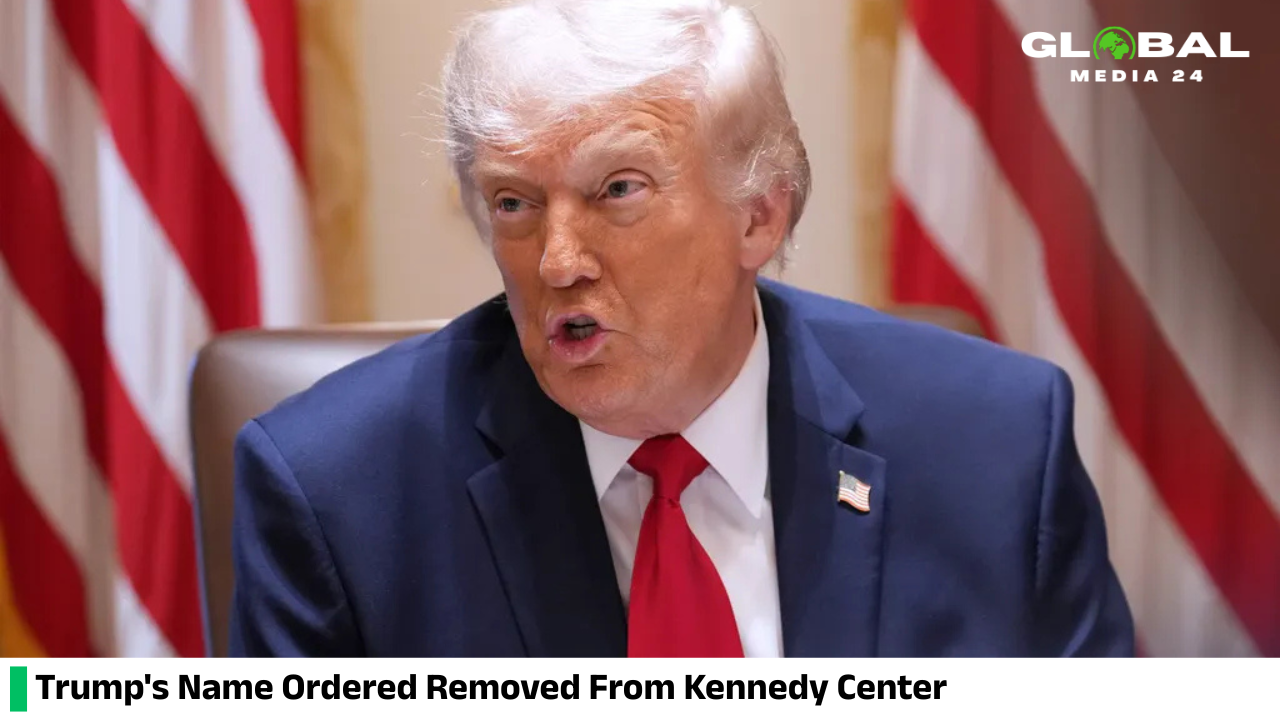
A US federal court has delivered a massive legal setback to Donald Trump, ordering the immediate stripping of his name from the iconic Kennedy Center. Get the full exclusive details here.
The legal landscape in Washington D.C. has witnessed a major shift following a decisive federal court order regarding one of the nation’s most prominent cultural landmarks. A United States federal judge has officially ruled that the name of Donald Trump must be immediately stripped from the John F. Kennedy Center for the Performing Arts. This landmark decision effectively nullifies a controversial rebranding effort initiated late last year, signaling a significant administrative defeat for the former president’s legacy initiatives, as detailed in recent reporting by The Guardian.
The comprehensive 94-page judicial opinion was handed down by Federal Judge Christopher Cooper of the U.S. District Court for the District of Columbia. The core of the legal argument focused on constitutional boundaries, with the court establishing that administrative boards do not possess the constitutional authority to alter titles designated by federal law.
The Controversy: How Did Trump’s Name Get On The Building?
To understand the court’s sudden intervention, it is necessary to examine the events of December last year. During that time, the Kennedy Center’s Board of Trustees pushed through a highly debated resolution. The board voted to alter the historic venue’s official title to “The Donald J. Trump and The John F. Kennedy Memorial Center for the Performing Arts.” Shortly after the vote, physical signs displaying Donald Trump’s name were erected outside the multi-theater complex in the nation’s capital. Concurrently, digital marketing platforms and official government literature were updated to reflect the dual naming system. The board initially defended this decision by pointing to structural funding plans and modernization projects proposed during the Trump administration.
However, the modification triggered immediate public outrage and fierce political opposition. Critics argued that adding a contemporary political figure’s name to a living national monument—established specifically to honor the memory of the assassinated 35th President, John F. Kennedy—was an insult to American history and a direct violation of federal statutes.
The Legal Battle and Judge Cooper’s Verdict
The mounting public dissatisfaction quickly transformed into a formal lawsuit. Democratic Representative Joyce Beatty, backed by an alliance of civic organizations and historical preservation groups, filed a legal challenge against the center’s leadership. The lawsuit argued that the Board of Trustees had overstepped their legal boundaries and violated the original 1964 Kennedy Center Act.
After reviewing the arguments, Judge Christopher Cooper ruled firmly in favor of the plaintiffs. According to the Washington Post analysis, he noted that the original legislation passed by the United States Congress left absolutely no room for local boards to experiment with the institution’s identity.
“Under explicit federal law, this facility functions strictly as a national monument to President John F. Kennedy,” Judge Cooper noted in his written verdict. “While the Board of Trustees is authorized to manage daily operations, they lack the legislative power to rewrite a congressional designation. An institution named by Congress can only be renamed by Congress.”
A Strict 14-Day Timeline for Total Removal
The federal injunction imposes a strict deadline on the theater’s management. The Kennedy Center has been given exactly 14 days to execute the following directives:
- Dismantle all physical exterior and interior signs that include the name ‘Donald Trump’.
- Purge the name from all digital frameworks, including the main website and electronic ticketing platforms.
- Update all promotional brochures, internal documents, and administrative letterheads.
Ambitious Modernization Projects Blocked by the Court
The legal repercussions of Judge Cooper’s decision extend far beyond a basic name change. As reported by Courthouse News Service, the court also issued a sweeping injunction that completely halts a massive infrastructure project tied to the original renaming agreement.
The Trump-backed revitalization framework included a controversial two-year total shutdown of the performing arts venue, which was scheduled to commence this coming July. The multi-million dollar plan aimed to completely redesign the interior theaters and upgrade the foundational infrastructure.
However, the court ruled that shutting down the complex entirely for 24 months directly conflicted with the center’s legal mandate to remain open to the public as a functional national treasure. Because of this sudden legal freeze, the financial backing and future timeline of these structural upgrades remain completely up in the air.
Trump Retaliates: “I Am Stepping Away From This Project”
Shortly after the court’s dramatic ruling was made public, Donald Trump took to his platform, Truth Social, to launch a sharp critique against the judicial system and announce his total withdrawal from the venue’s future.
In an official public post, Trump claimed that his involvement and the proposed rebranding were designed purely to rescue a facility that he described as financially broken and culturally irrelevant. He asserted that if his team’s vision for a highly advanced, world-class entertainment hub was going to be blocked by legal challenges, he had no interest in continuing his support.
Trump concluded his statement by declaring that he is officially handing over all operational control, maintenance burdens, and financial liabilities directly back to the U.S. Congress, effectively distancing himself entirely from the ongoing legal drama.