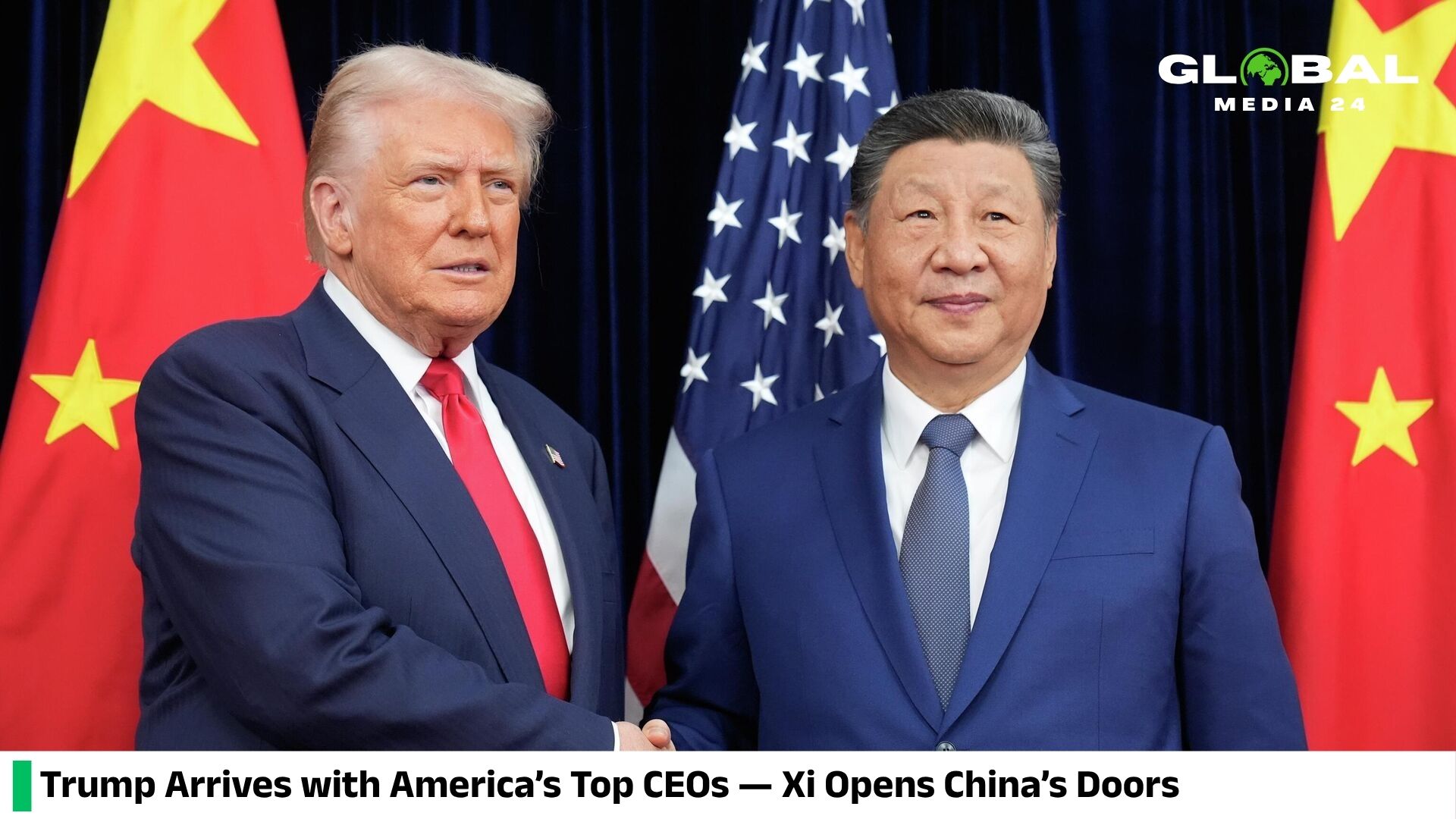
At the Trump–Xi Summit, Xi Jinping told US business leaders that American companies will enjoy greater opportunities and a more promising future in China.
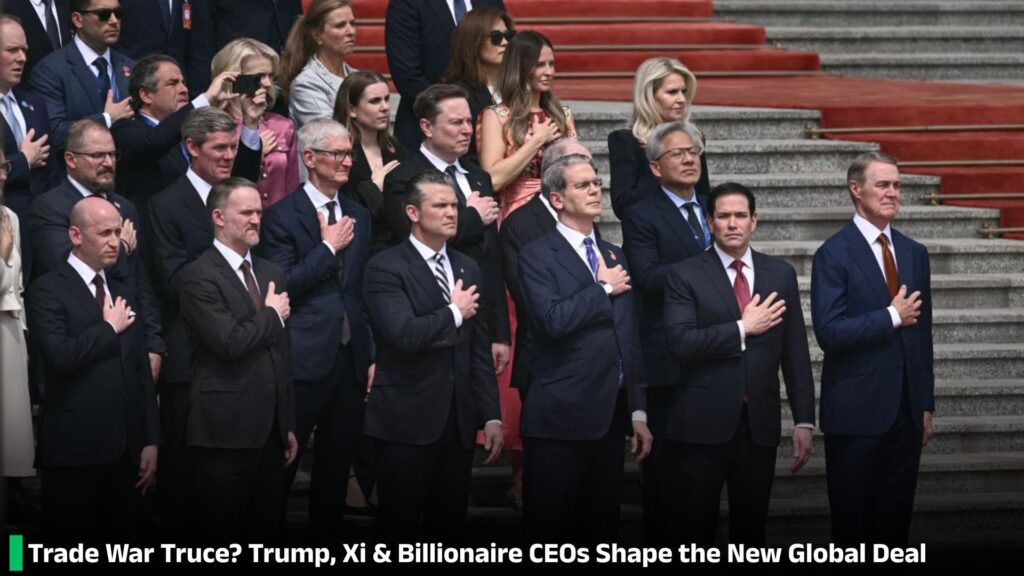
Trump-Xi Meeting: When U.S. President Donald Trump arrived at the Great Hall of the People on Thursday morning, he did not come alone. He was accompanied by the CEOs of some of America’s largest companies.
From Elon Musk and Tim Cook to Jensen Huang, Larry Fink, Jane Fraser, and David Solomon—this visit felt less like a diplomatic mission and more like a high-stakes corporate expedition. Seated on the other side of the table was Chinese President Xi Jinping.
What is on the agenda? Iran. Taiwan. Rare earths. AI. Tariffs. Market access. Just about everything. But the real conversation revolves around trade (and market access).
Trump-Xi Summit: An Attempt to De-escalate the Trade War
Both economies (the U.S. and China) are still feeling the aftershocks of last year’s tariff war. Tariffs soared to over 100 percent. Supply chains were disrupted. Inflation rose in the U.S., while exports slowed down in China.
When the two leaders met in South Korea in October, they agreed upon a temporary truce. Now, that ceasefire is set to be extended. Trump needs a deal that will appease the markets.
Xi, meanwhile, requires stability at a time when China’s economy is under strain due to weak demand, property sector woes, and sluggish exports. This meeting represents an effort to prevent the trade war from reigniting. Team Trump: America’s Top CEOs Arrive in China
Here is the complete list of executives joining Trump in China as part of the official U.S. delegation:
Elon Musk, Tesla, SpaceX
Jensen Huang, Nvidia
Tim Cook, Apple
Larry Fink, BlackRock
Dina Powell McCormick, President and Vice Chair, Meta
Kelly Ortberg, President and Chief Executive, Boeing
Ryan McInerney, Chief Executive, Visa
Stephen Schwarzman, Chief Executive, Blackstone
Brian Sikes, Chief Executive and Chairman, Cargill
Jane Fraser, Chief Executive, Citi
Jim Anderson, Chief Executive, Coherent
H. Lawrence Culp Jr., Chief Executive, GE Aerospace
David Solomon, Chief Executive, Goldman Sachs
Jacob Thaysen, Chief Executive, Illumina
Michael Miebach, President, Mastercard
This delegation is not merely symbolic. Every CEO on the plane has a specific request for Beijing. Tesla is seeking approval for its Full Self-Driving system, as well as clearance to import $2.9 billion worth of Chinese solar equipment.
Nvidia wants China to approve the purchase of its AI chips.
Apple seeks regulatory stability within its largest manufacturing base.
BlackRock is facing a Chinese investigation regarding a $23 billion ports deal linked to Panama.
Illumina remains on China’s list of “unreliable” companies.
Mastercard and Visa are seeking deeper access to China’s payments market.
Boeing is looking for aircraft orders. Cargill seeks substantial purchases of grain and meat.
During a meeting with U.S. business leaders, Xi stated that China’s doors would open even wider for U.S. businesses. He added that there would be greater opportunities for American companies within the country.
Furthermore, Xi acknowledged that American companies have been deeply involved in China’s growth, a dynamic that has benefited both sides.
According to China’s state-run media outlet, Xinhua, the Chinese President remarked, “Beijing welcomes the United States to strengthen mutual cooperation.”
What Trump Wants from Xi
Trump’s public stance is straightforward: “Open up China.” Underlying this slogan are three concrete demands:
Easier market access for U.S. companies.
Increased purchases of U.S. goods—specifically soybeans, LNG, and aircraft—by China.
A framework for reducing tariffs on approximately $30 billion worth of goods without compromising national security.
The U.S. President also seeks an end to China’s weaponization of supply chains—particularly regarding rare earths and critical minerals that power the U.S. technology and defense industries.
However, since their previous meeting, China has demonstrated its capacity to inflict damage upon vulnerable U.S. sectors by tightening restrictions on rare-earth exports.
The conflict with Iran has also diverted Washington’s attention. As the largest purchaser of Iranian oil, China now possesses a geopolitical leverage that Trump cannot afford to ignore.
Trump has shifted his tone—moving from threats of tariffs to hailing Xi as a “great friend.” It appears that, in these negotiations, the balance of power may be tipping in China’s favor.
Tehran and Taiwan: The Elephants in the Room
One cannot overlook the fact that the crisis in the Strait of Hormuz looms large over these negotiations. China is heavily dependent on Gulf oil transported through the Strait of Hormuz. The United States, for its part, seeks to avert an energy shock. Trump will likely ask Xi to use Beijing’s influence over Tehran to de-escalate tensions and reopen shipping lanes. Even if Iran does not grab the headlines, it remains a silent driver of this urgency.
Meanwhile, Trump has stated that he will discuss U.S. arms sales to Taiwan—a sensitive shift, as Washington typically refrains from consulting Beijing on this matter.
Both sides are also considering initiating their first formal dialogue regarding AI risks. Controls on rare earth exports, semiconductor rivalry, and restrictions on biotechnology are all part of the conversation, as these issues directly impact the CEOs seated behind Trump.
Trump-Xi Summit: The Possibility of Tariff Negotiations
The key outcome the markets are watching for: an extension of the year-long tariff truce. Both sides are contemplating a framework under which specific tariffs on goods worth approximately $30 billion would be reduced.
This is not a grand trade deal; rather, it is a managed trade framework—stability, if not outright friendship. For Trump, extending the tariff ceasefire, securing purchases of agricultural products, and generating headlines about China opening its markets will be counted as victories. For Xi, the headline takeaways will be the absence of new tariffs, controlled concessions, and maintaining a stable relationship without yielding strategic ground.
Neither side is seeking a breakthrough; rather, they aim to avoid another breakdown.
Trump-Xi Summit: What It Means for India
This meeting holds far greater significance for India than it might appear on the surface. If U.S.-China trade relations improve, the “China Plus One” manufacturing momentum—beneficial to India—could lose steam. Conversely, if the Strait of Hormuz reopens and oil prices cool down, India stands to gain immediate benefits.
If Trump softens his stance on Taiwan, U.S. strategic pressure on China would diminish—an outcome that does not serve New Delhi’s interests well. Furthermore, if Chinese exports receive tariff relief, Indian sectors such as steel, solar energy, chemicals, and electronics will face even stiffer competition. Therefore, despite the ongoing BRICS Summit in New Delhi, India is keeping a close watch on developments in Beijing.