Ukraine–Russia Enter Second Phase of US-Brokered Peace Talks in Abu Dhabi
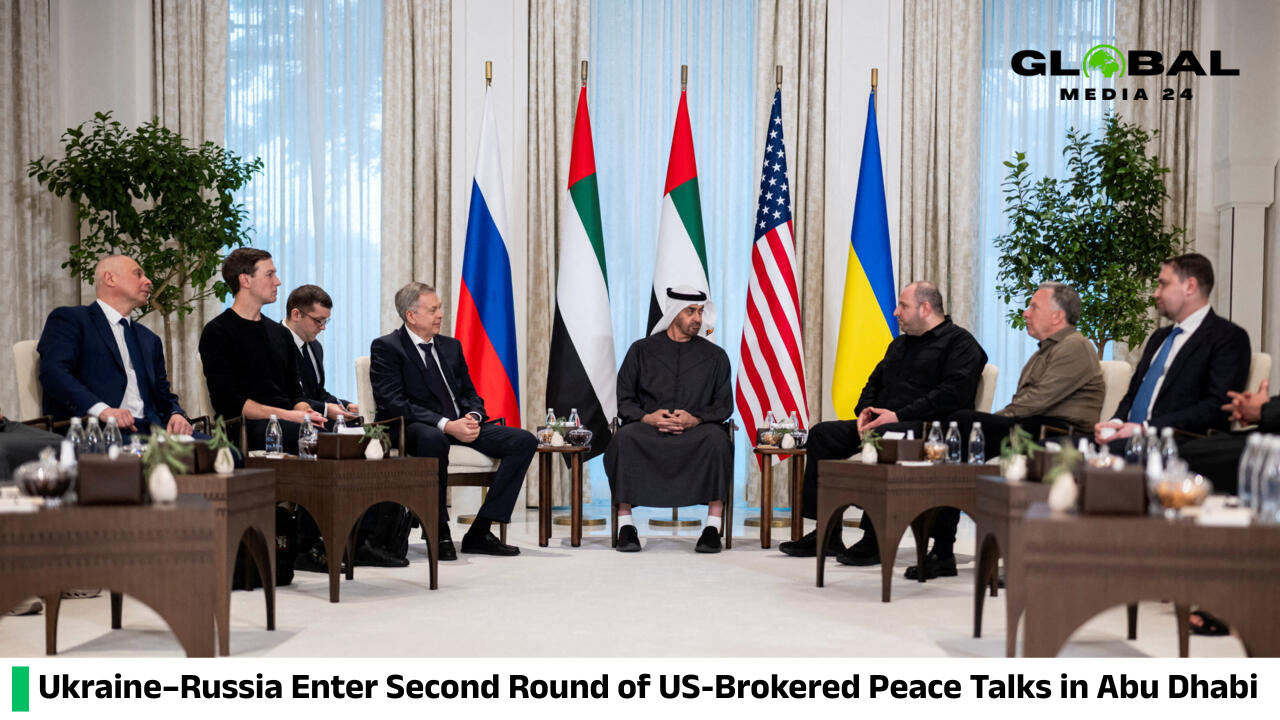
Significant barriers to a viable deal continue as Volodymyr Zelenskyy claims Moscow has violated the energy truce.
Ukrainian and Russian negotiators have begun a second round of US-led peace talks in Abu Dhabi, as Washington seeks a path to end the nearly four-year-old war in Ukraine.
The two-day, three-way talks, which began on Wednesday, come after Volodymyr Zelenskyy accused Russia of exploiting a US-backed energy deal last week to stockpile weapons before launching a record number of ballistic missile attacks on Ukraine on Tuesday.
Despite the Trump administration’s renewed diplomatic efforts, the prospects for a successful peace deal remain uncertain, as Moscow continues to insist on its maximalist territorial demands.
The Kremlin has repeatedly stated that any agreement must include Ukraine ceding the entire eastern Donbas region, including areas still under Ukrainian control.
Kyiv has rejected such terms, insisting that fighting must cease along the current front lines and ruling out the possibility of a unilateral withdrawal of its forces.
Other significant obstacles remain. Moscow has said it will not tolerate European troops on Ukrainian soil, a condition Kyiv considers essential for credible security guarantees.
Speaking to the Ukrainian parliament on Tuesday, NATO Secretary General Mark Rutte said that European allies had pledged to send troops to Ukraine after a deal is reached—a proposal Russia has so far categorically rejected.
Kremlin spokesperson Dmitry Peskov said on Wednesday that the Russian army would continue fighting until Kyiv makes “decisions” that would end the war. This underscored Moscow’s hardline stance, even as negotiations resumed.
Kyiv suffered a diplomatic setback ahead of the talks when Trump refused to condemn Russia for attacking Ukraine’s energy grid with missiles and drones despite a declared ceasefire.
Following the attacks, Zelenskyy wrote, “For Russia, it is more important to use the coldest days of winter to terrorize people than to resort to diplomacy.” He appealed to Western governments to condemn the attacks.
Trump later said on Tuesday that Vladimir Putin had “kept his word” on the ceasefire, adding that Russia’s halt to attacks was only until Sunday.
The second round of talks was initially scheduled to begin in Abu Dhabi on Sunday but was postponed until Wednesday due to rising tensions in the region over Iran.
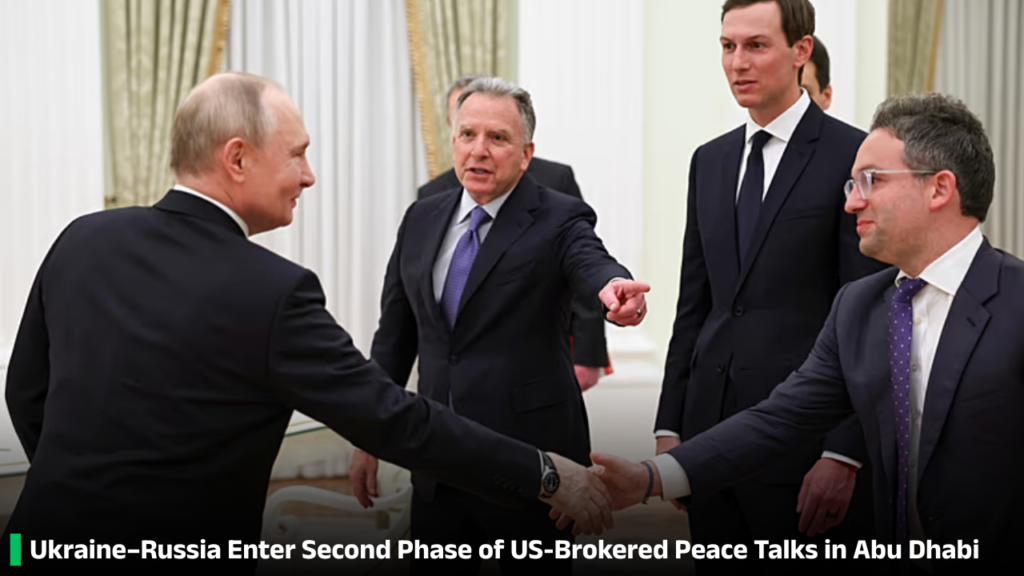
US Special Envoy Steve Witkoff and Donald Trump’s son-in-law Jared Kushner traveled to Abu Dhabi for the talks. Both have become key figures in US diplomacy, shuttling between discussions on the Middle East, the Iran crisis, and the war in Ukraine, but have faced criticism for their lack of formal diplomatic experience.
The Ukrainian team includes Kyrylo Budanov, the former head of military intelligence who now leads the Presidential Administration, and General Staff Chief Andriy Hnatov.
The Russian delegation is led by Igor Kostyukov, head of the GRU military intelligence service, along with other senior intelligence officials and Kremlin investment envoy Kirill Dmitriev.
A potential meeting between Putin and Zelenskyy is being discussed, but the Kremlin has said it would only agree to such talks if the Ukrainian leader were willing to travel to Moscow.
In a show of wartime solidarity, Putin spoke with Chinese President Xi Jinping via video call on Wednesday, with both leaders praising the strength of their bilateral relations.
Despite harsh Western sanctions, China has emerged as a crucial economic lifeline for Russia, increasing its trade and purchases of Russian oil.
Ukraine and several European governments have accused Beijing of supplying weapons to Russia, but China denies these allegations.
Washington has also previously pressured India, another close partner of Moscow, to halt its purchases of Russian oil, which Western countries say helps finance Putin’s war.
The UAE’s neutrality is not passive. They say, “You have to maintain a significant distance from both this party and that party.” “And you have to demonstrate that you are saying the same thing in public and behind closed doors.”
In today’s geopolitical environment, where channels of communication are closing faster than conflicts are being resolved, this consistency is an asset.
The UAE’s growing role as a convener is neither accidental nor impulsive. It is the result of deliberate prudence at a time when those who escalate tensions are often rewarded.
As the next round of US-Ukraine-Russia talks approaches and pressure mounts on Iran, the UAE is positioning itself not as a commentator on global crises, but as a calming voice amidst them.