Trump Seeks $100bn Venezuela Oil Deal, Exxon Boss Raises Red Flag
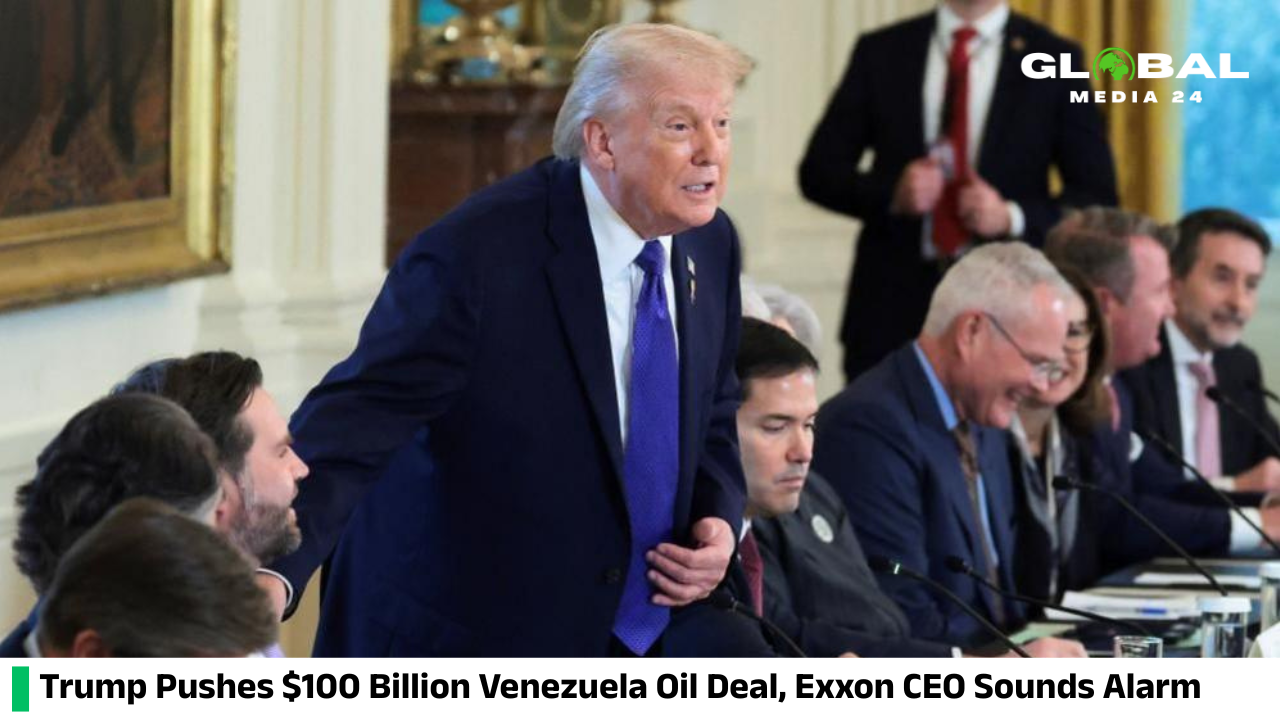
US President Donald Trump has called for at least $100bn (£75bn) in oil-sector investment in Venezuela, but the proposal drew a muted reaction at the White House, with one industry leader saying the country is currently “uninvestable.”

The heads of the largest US oil companies who attended the meeting acknowledged that Venezuela, sitting on vast energy reserves, presents a significant opportunity.
However, they said that major changes would be needed to make the country an attractive investment. No major financial commitments were made immediately.
Trump has said he would open up the South American country’s oil reserves if the US military seized its leader, Nicolás Maduro, in a raid on the capital, which he suggested could happen on January 3.
“One of the things that will happen for the United States is energy prices will go down even further,” Trump said at the White House meeting on Friday. But the oil executives present expressed caution.
Exxon CEO Darren Woods said, “Our assets have been expropriated there twice, and so you can imagine that to go back in a third time, there would have to be some very significant changes from what we’ve seen before and what the current situation is.”
“Right now, it’s not considered an investable environment.”
Venezuela’s relationship with international oil companies has been fraught since oil was discovered there more than 100 years ago. Chevron is the last major American oil company still operating in the country.
Several companies from other countries are also active, including Spain’s Repsol and Italy’s Eni, both of which were represented at the White House meeting.
Trump said his administration would determine which firms would be allowed to operate.
The White House says it is working to “selectively” lift US sanctions that have blocked Venezuelan oil sales.
Officials say they are coordinating with interim authorities in the country, who are currently led by Nicolás Maduro’s former second-in-command, Vice President Delcy Rodríguez.
However, they have also made it clear that they intend to maintain control over the sales to retain leverage over Rodríguez’s government.
This week, the US seized several oil tankers carrying sanctioned crude oil. US officials said they are working to set up a sales process that would deposit the proceeds into US-controlled accounts.

In recent decades, Venezuela’s oil production has been hampered by disinvestment and mismanagement, as well as US sanctions. At approximately one million barrels per day, the country accounts for less than 1% of global supply.
Chevron, which accounts for roughly a fifth of the country’s total production, said it expects to increase production given its existing presence, while Exxon said it is working on sending a technical team to assess the situation in the coming weeks.
Repsol, which currently produces about 45,000 barrels per day, said it sees a path to tripling its production in Venezuela over the next few years under the right conditions.
Executives from other companies also said that Trump’s promises of change would encourage investment and that they were hoping to capitalize on the opportunity.
“We’re ready to go to Venezuela,” said Bill Armstrong, who heads an independent oil and gas driller. “In real estate terms, it’s prime real estate.” But analysts say that significantly increasing production will require considerable effort.
“They’re being as polite as they can be and as supportive as they can be without actually putting any real money in,” said David Goldwyn, president of energy consultancy Goldwyn Global Strategies and a former special envoy for international energy affairs at the US State Department.
Goldwyn said that Exxon and Shell “are not going to make single-digit billion-dollar investments, let alone tens of billions of dollars, without physical security, legal certainty, and a competitive fiscal framework.”
“From an industry perspective, this is really not good,” he said. “The situation is not good.” While smaller companies might be more eager to help boost Venezuelan oil production next year, he said these investments would likely be around $50 million — a far cry from the “spectacular” $100 billion figure cited by Trump.
Rystad Energy estimates that tripling production by 2040 would require $8 billion to $9 billion in new investment every year. Trump’s $100 billion investment in Venezuela, if it materialized, could have a significant impact on production, said Claudio Galimberti, the firm’s chief economist.
He said companies would only invest on such a massive scale if they received subsidies and political stability. He added that Americans shouldn’t expect the situation in Venezuela to lower oil prices anytime soon.
“Until the political situation is completely stable, it’s going to be difficult to see major commitments, and when that will happen is anyone’s guess,” he said.