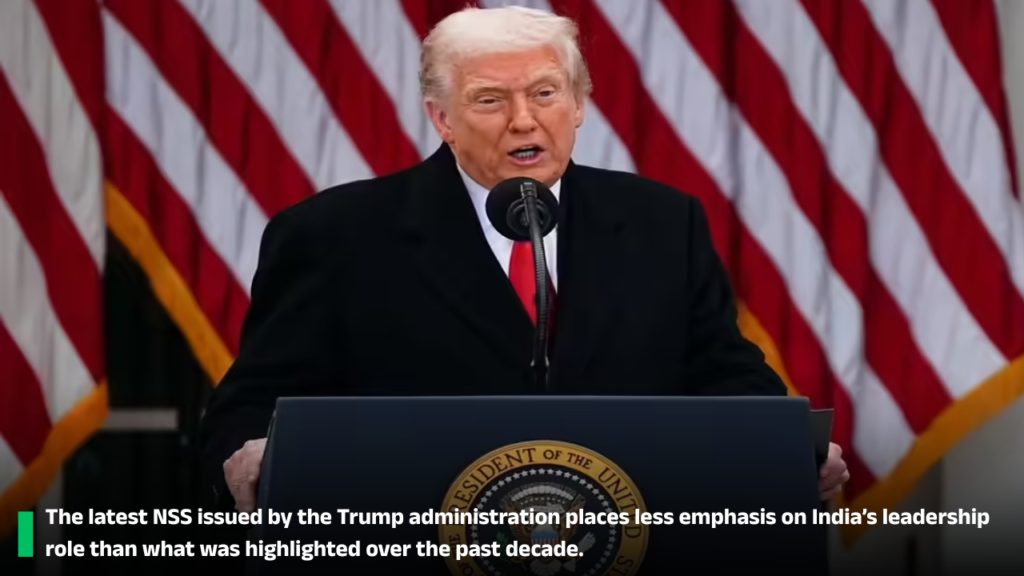
The latest National Security Strategy issued by the Trump administration places less emphasis on India’s leadership role than what was highlighted over the past decade
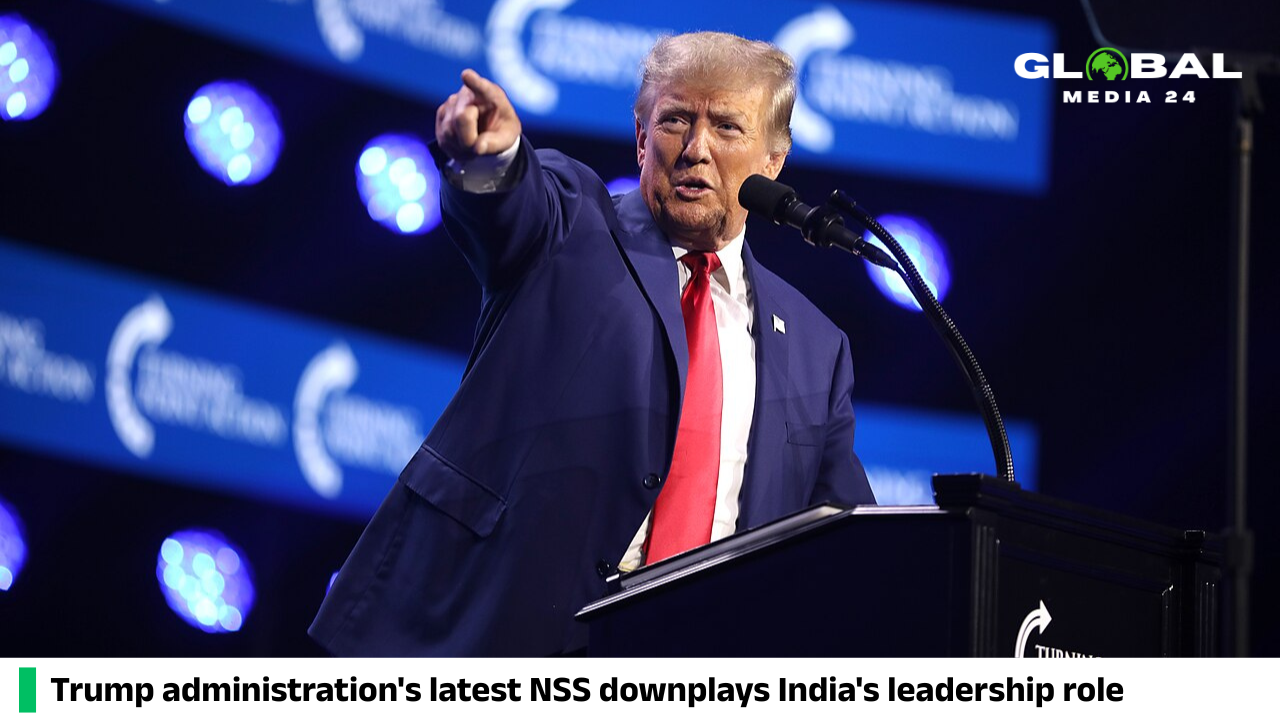
A review of the latest document indicates a departure from the Biden administration’s ‘Major Defense Partner’ label and from the ‘leading global power’ title used during Donald Trump’s first term, shifting the focus instead toward reciprocal trade commitments and a stronger sharing of responsibilities.
New Delhi:
Breaking from the strategic warmth that defined the past ten years, the Trump administration’s second-term National Security Strategy (2025) reflects a noticeable shift in tone—India is no longer highlighted as prominently in Washington’s agenda, with the document leaning more toward a distinctly transactional posture.
An analysis of the newly released document shows a shift away from the “major defense partner” status granted by the Biden administration and the “leading global power” designation of Donald Trump’s own first term, with an emphasis now on trade reciprocity and burden-sharing.
The NSS is a legally mandated report that each new administration must send to Congress, outlining its national security vision.
While New Delhi remains a key player in the Indo-Pacific, the 2025 strategy mentions India fewer times and with less strategic weight than the Biden administration’s 2022 report. India was mentioned seven times during the Biden period, while India appears only four times.
“We must continue to improve trade (and other) relations with India to encourage New Delhi to contribute to Indo-Pacific security, including through continued quadrilateral cooperation with Australia, Japan, and the United States (the ‘Quad’),” states the 2025 strategy, which represents one of its few significant references to India.
The report also said that India should be part of efforts to bring together allies and partners to “strengthen and improve our joint position in the Western Hemisphere and in Africa with respect to important minerals.”
Another reference is to securing the South China Sea. “If this problem is not resolved, this will require not only greater investment in our military, especially naval, capabilities, but also stronger cooperation with every nation that will be affected, from India to Japan and beyond.”
Once again reiterates the assertion that he resolved the India–Pakistan dispute
As The Wire has reported, the first mention is a claim made in the context of recent history.
President Trump stated in his first letter that his administration had “resolved eight violent conflicts,” specifically mentioning the conflict between “Pakistan and India.”
This claim that the US brokered “peace talks” between the nuclear-armed neighbors has been repeated publicly by Trump more than fifty times, while India has publicly denied the claim, stating that the four-day standoff in May ended with talks between the two armies.
The contrast with the Biden administration’s 2022 strategy is striking. That document described India as “the world’s largest democracy and a major defense partner” and stated that “the United States and India will work together bilaterally and multilaterally to support our shared vision of a free and open Indo-Pacific.”
Similar to the 2022 strategy, the Trump administration’s December 2017 National Security Strategy also mentioned India as a rising power. It stated, “We welcome India’s emergence as a leading global power and a strong strategic and defense partner.”
The Obama administration consistently focused on India in both of its strategies.
The 2015 document stated, “We will continue to strengthen our strategic and economic partnership with India,” and described the relationship with “the world’s largest democracy” as being based on “shared values and mutual interests.” It supported “India’s role as a regional security provider and its expanded participation in key regional institutions.”
The 2010 Obama administration strategy placed India among the “other centers of influence of the 21st century” alongside China and Russia, emphasizing “deeper and more effective partnerships” and including working with India to “promote strategic stability, combat terrorism, and advance regional economic integration in South and Central Asia.”
The Quadrilateral Security Dialogue, or Quad, is also rarely mentioned. The Biden administration’s 2022 report mentioned the “revitalized Quad” six times, presenting it as a key partnership for delivering vaccines and climate solutions.
The Quad is mentioned only once in the 2025 strategy, and only as a means to “encourage” India’s security partnership.
The Trump administration’s 2025 strategy made only one mention of Pakistan—and that reference was to take credit for “negotiating peace between Pakistan and India” as one of eight conflicts the administration resolved in its first eight months in office.
However, the lack of mention today contrasts with the negative outlook in the Trump administration’s previous strategy, which was critical of both Afghanistan and the fight against terrorism, reflecting deteriorating relations.
The Biden administration’s 2022 strategy did not mention Pakistan once—a far cry from the strategic partnership language of the Obama years.
China has remained a focal point of U.S. national security strategy, though the nature and intensity of that focus have changed significantly.
The Biden administration’s 2022 strategy describes China as “America’s most consequential geopolitical challenge” and “a single competitor and, increasingly, an economic, diplomatic, military, and technological power intent on reshaping the international order.”
The Trump administration’s 2025 strategy shifts the focus of relations primarily from geopolitical competition to economic rebalancing.
The strategy states, “President Trump alone has overturned more than three decades of flawed American thinking about China,” and details how “American elites—across four consecutive administrations of both political parties—have either willfully accepted or ignored the flawed China strategy.”
The Asia section of the document is titled “Win the Economic Future, Deter Military Conflict,” emphasizing that “in the long run, maintaining American economic and technological superiority is the surest way to deter and prevent large-scale military conflict.”
The strategy states that China “has grown wealthy and powerful and has used its wealth and power to its considerable advantage” and details how Beijing has strengthened its grip on global supply chains. “Between 2020 and 2024, China’s exports to low-income countries doubled. The United States indirectly imports Chinese goods through intermediaries in a dozen countries, including Mexico, and through factories built in China.”
The strategy calls for trade with China to be “balanced and focused on non-sensitive sectors,” aiming to restore “American economic freedom” through “reciprocity and fairness.”