Pakistan raises petrol prices by 43% and diesel by 55% amid the US-Iran conflict

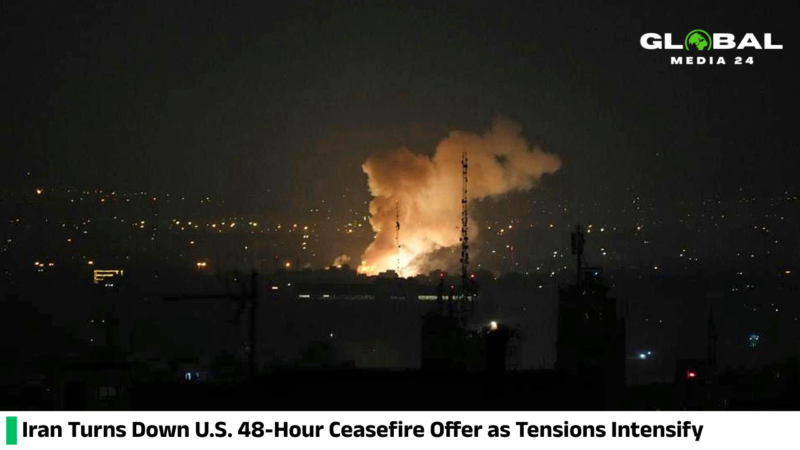
The US–Israel conflict with Iran, which began on February 28, has thrown the Middle East into turmoil, as Iran’s counterattacks have struck targets across the Gulf and brought shipping in the Strait of Hormuz to a near standstill.

Pakistan’s petroleum minister stated during a press conference that, in response to the global surge in energy prices caused by the war in Iran, the Pakistani government implemented a substantial hike in fuel prices on Thursday.
Under the new pricing structure, the cost of petrol has risen by 42.7 percent, while diesel prices have increased by 54.9 percent.
Minister Ali Pervaiz Malik remarked, “In accordance with the decision reached today—and aligned with international market trends—the new price for petrol, following the upward revision, will be 458.40 rupees ($1.64 per liter); this rate will come into effect tomorrow (Friday).”
He added that the price of diesel has been fixed at 520.35 Pakistani rupees ($1.86) per liter—a commodity, he noted, “that is vital for our workforce and public transportation.”
Pervaiz further stated, “While keeping its budgetary constraints in mind, the government has made every possible effort to provide full protection to the public”; however, it was ultimately “compelled” to raise prices “because resources are finite, and we currently see no indications that this conflict is nearing an end.”
The US-Israel conflict against Iran, which began on February 28, has plunged the Middle East into hostilities; Iran’s retaliatory strikes are targeting sites across the Gulf, and shipping in the Strait of Hormuz has ground to a near standstill.
This vital waterway typically carries one-fifth of the world’s energy supply, the majority of which is destined for Asia.
Pakistan is heavily dependent on such oil and gas supplies; consequently, on March 6—approximately one week after the outbreak of hostilities—the country raised fuel prices by 20 percent.
To conserve fuel, the government has implemented several stringent measures, including a four-day workweek for many government offices, extended school holidays, and a shift to online learning for certain classes.
According to World Bank data, Pakistan is classified as a lower-middle-income country, where approximately 25 percent of its population of 240 million lives in poverty.
To mitigate the crisis stemming from the conflict involving Iran, several Asian nations have either raised fuel prices or implemented alternative measures.
On Thursday, Bangladesh increased the prices of liquefied petroleum gas (LPG)—commonly used for cooking—and compressed natural gas (CNG)—used in certain vehicles—by 29 percent.
Earlier this week, the International Monetary Fund (IMF) warned that vulnerable economies like Pakistan face pressure not only from elevated energy prices but also from disruptions to supply chains.
In a post on its website, the IMF stated: “Parts of the Middle East, Africa, the Asia-Pacific region, and Latin America are facing additional pressure due to high food and fertilizer prices, as well as tightening financial conditions.”