India–France Relations Decoded: A “Special Global” Partnership in Defense, AI, and Nuclear Strategy
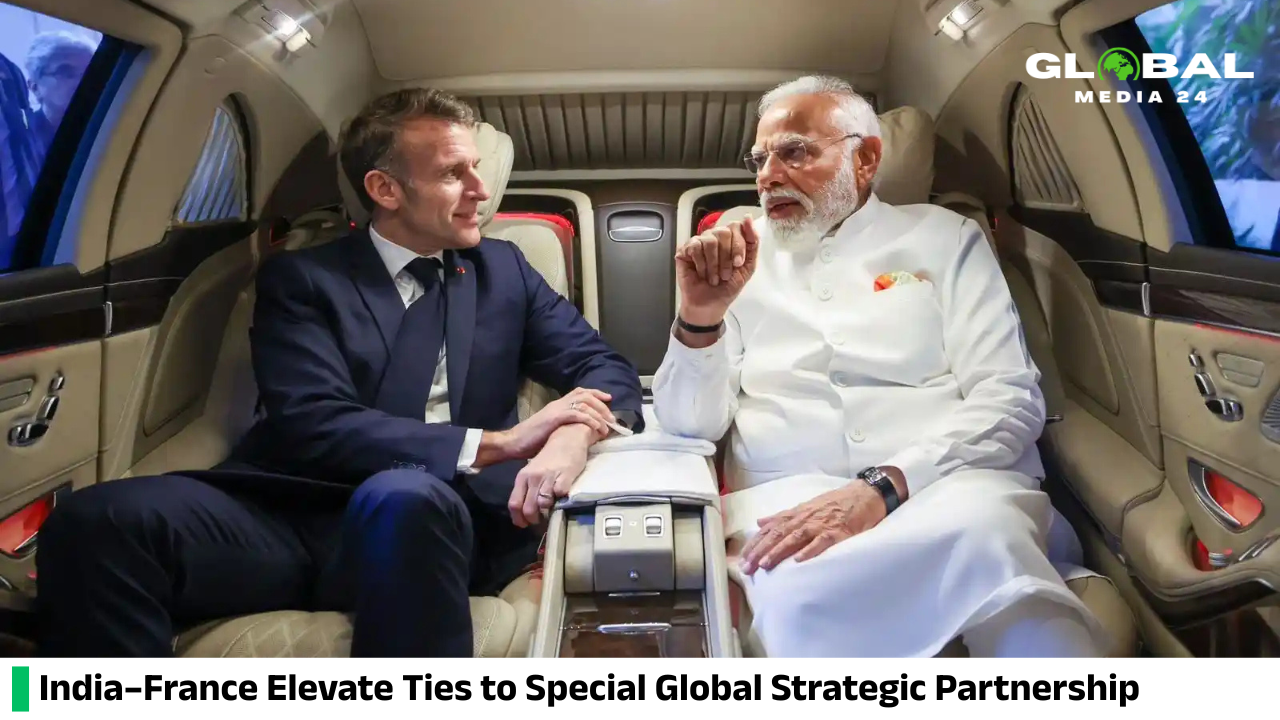
The central highlight of the announcement was the move to elevate the strategic partnership established in 1998 into a special global strategic partnership, signaling a greater level of ambition and commitment from both sides.
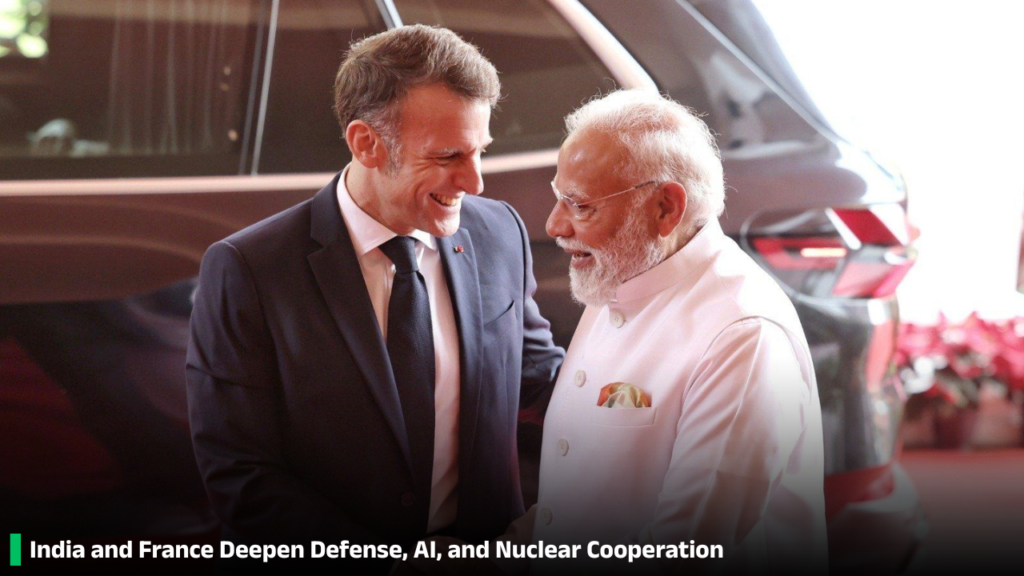
India and France have announced a major upgrade of their relationship to a “Special Global Strategic Partnership,” a significant step to further strengthen cooperation in defense, artificial intelligence, nuclear energy, space, climate action, and global governance.
This move follows talks between Prime Minister Narendra Modi and French President Emmanuel Macron in Mumbai, marking Macron’s fourth visit to India, and reflects the growing strategic convergence between New Delhi and Paris.
The upgrade of the relationship, announced in a joint statement issued on February 17, signals that India and France now view each other not just as bilateral partners but as long-term collaborators shaping global economic, security, and technological outcomes in an increasingly fragmented world.
From Strategic to “Special Global” Partnership
At the heart of this declaration was the decision to elevate the existing Strategic Partnership—which began in 1998—to a Special Global Strategic Partnership, a move that reflects the level of ambition on both sides.
Officials stated that the upgraded framework will guide cooperation for decades, aligning with the “Horizon 2047 Roadmap,” which outlines bilateral relations for the centenary of India’s independence and 50 years of the India-France Strategic Partnership.
To institutionalize the new relationship, the two sides announced an annual comprehensive foreign ministers’ dialogue, aimed at tracking progress in economic security, global challenges, and people-to-people ties.
This move signals strong political convergence at a time when both countries are grappling with shifting alliances, supply chain vulnerabilities, and rising geopolitical tensions.
Defense cooperation emerged as the most concrete and headline-making pillar of the talks.
India and France agreed to accelerate the co-design, co-development, and co-production of advanced defense platforms, including air, naval, and land systems, as well as dual-use and new technologies.
A major milestone was the approval of a contract for 26 Rafale Marine fighter jets for the Indian Navy, further strengthening France’s position as one of India’s largest defense partners.
Both sides also expressed a desire to deepen cooperation in the production of fighter aircraft and fighter engines under the Make in India initiative, with French aerospace company Safran expanding its presence in India.
Among the key announcements were
The inauguration of maintenance, repair, and overhaul (MRO) facilities for the LEAP and M-88 engines.
A joint venture with Bharat Electronics Limited to manufacture the HAMMER missile in India.
and the H125 helicopter final assembly line, the first private sector helicopter manufacturing facility of its kind in India, supported by Tata Advanced Systems and Airbus.
France also expressed interest in India’s Pinaka multi-barrel rocket launcher, suggesting the potential for future exports and co-development.
Submarine, Space, and Cyber Cooperation
The leaders commended the success of the Scorpene submarine program, noted the delivery of the sixth Kalvari-class submarine to the Indian Navy earlier this year, and reaffirmed continued submarine cooperation.
In space, India and France agreed to enhance cooperation on sovereign access to space, space situational awareness, and defense space, building on the existing relationship between ISRO (Indian Space Research Organization) and CNES (France’s Centre National d’Etudes Spatiales).
India also confirmed its participation in the International Space Summit in France in July 2026, emphasizing increased coordination in multilateral space governance.
Cybersecurity also featured prominently, with both sides pledging regular bilateral cyber dialogue and greater coordination at the United Nations on rules for responsible state behavior in cyberspace.
AI Takes Center Stage
Artificial intelligence was a key topic of Macron’s visit, with the French president attending the AI Impact Summit 2026 in Mumbai.
The leaders reaffirmed their shared vision of “secure, trustworthy, and people-centered AI,” based on the India-France AI Declaration adopted in Paris last year.
Both countries pledged to democratize AI resources, bridge the global AI divide, and promote openness while addressing risks.
As part of this growing digital partnership, France’s role as co-chair of an essential working group on resilience and innovation was recognized.
Nuclear Energy and Climate Cooperation
In a significant signal on the energy transition, President Macron praised India’s vision of reaching 100 GW of nuclear power capacity by 2047 and welcomed recent reforms that have allowed private investment in the nuclear sector.
The two sides agreed to deepen cooperation across the nuclear value chain, including large reactors, small modular reactors (SMRs), and advanced modular reactors (AMRs).
The long-stalled Jaitapur Nuclear Power Plant project was discussed, as were plans for enhanced cooperation between Indian and French nuclear regulators and research bodies.
Climate and sustainability became another major pillar, with both leaders reaffirming their commitment to the Paris Agreement, the International Solar Alliance, and the Coalition for Disaster Resilient Infrastructure.
They also supported expanding marine protected areas and strengthening ocean governance, following the entry into force of the High Seas Biodiversity Treaty.
Big Multilateral Signals: G7, UNSC, and Global Order
On the diplomatic front, Macron officially invited PM Modi to attend the G7 Summit in France in 2026, emphasizing India’s growing role in shaping global economic and development debates.
PM Modi welcomed the invitation, which demonstrates India’s readiness to contribute to discussions on macroeconomic imbalances, robust supply chains, and climate action.
France reiterated its strong support for India’s permanent membership in the UN Security Council, and the two leaders agreed to work together on UNSC reform and discussions on reducing the use of the veto in cases of mass atrocities.
Both sides also reiterated their commitment to a rules-based Indo-Pacific, cooperation with the EU, and initiatives such as the India-Middle East-Europe Economic Corridor (IMEC).
People-to-People, Mobility, and Culture
Beyond geopolitics, the statement outlined a broader agenda for people-to-people relations.
France announced plans for visa-free transit for Indian citizens at French airports, initially as a six-month pilot project.
Both sides reiterated the goal of welcoming 30,000 Indian students to France by 2030, tripling the current number.
Cultural cooperation will be promoted through the India-France Year of Innovation 2026, increased residencies, museum collaborations, and the upcoming edition of “Namaste France.” In the field of health, a new AI-focused research center will be launched, bringing together major institutions from India and France.
Partnership for an Uncertain World
Overall, these announcements signal a mature partnership that encompasses hard security, cutting-edge technology, climate action, and global governance.
By elevating the relationship to a Special Global Strategic Partnership, India and France have positioned themselves as like-minded forces seeking autonomy, strength, and influence in a changing international environment.
As the joint statement puts it, the new framework opens “a new chapter” in the relationship – one in which both sides clearly seek to shape the global order, rather than merely adapt to it.