India and the European Union have unveiled a historic trade agreement
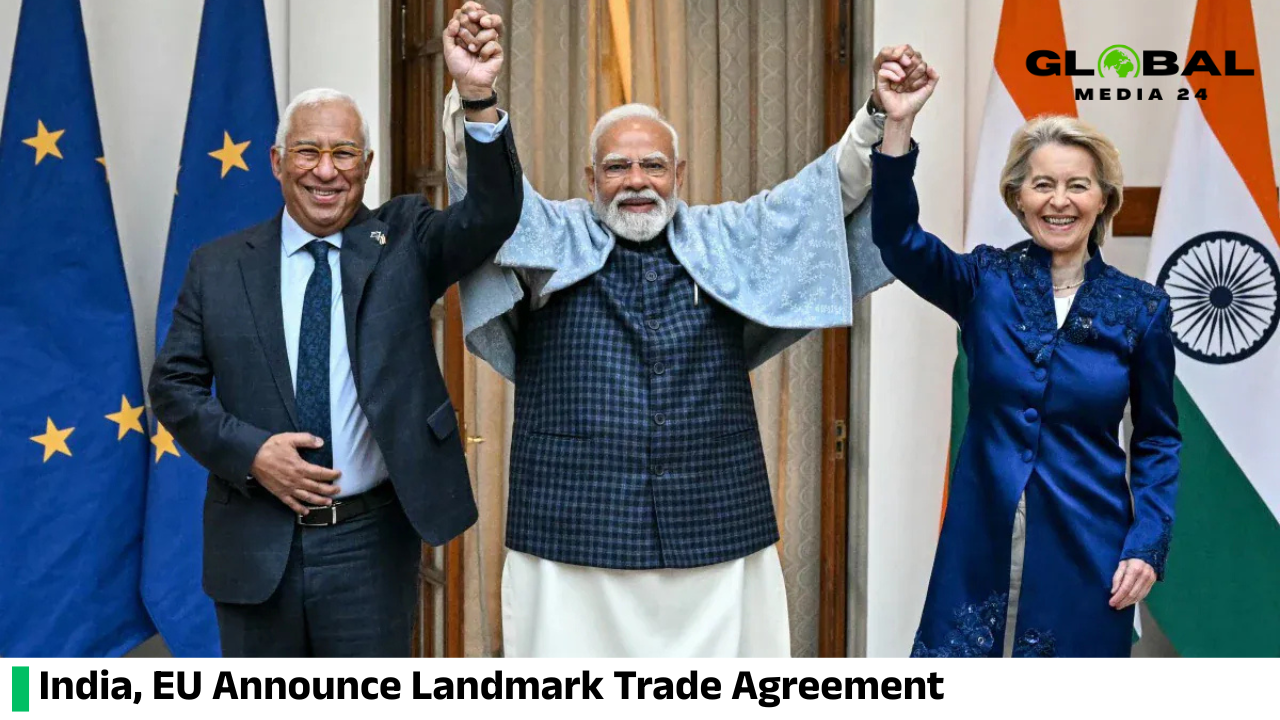
India and the EU have finalized a significant trade deal following years of sporadic talks, underscoring their push to deepen relations as frictions with the United States grow.
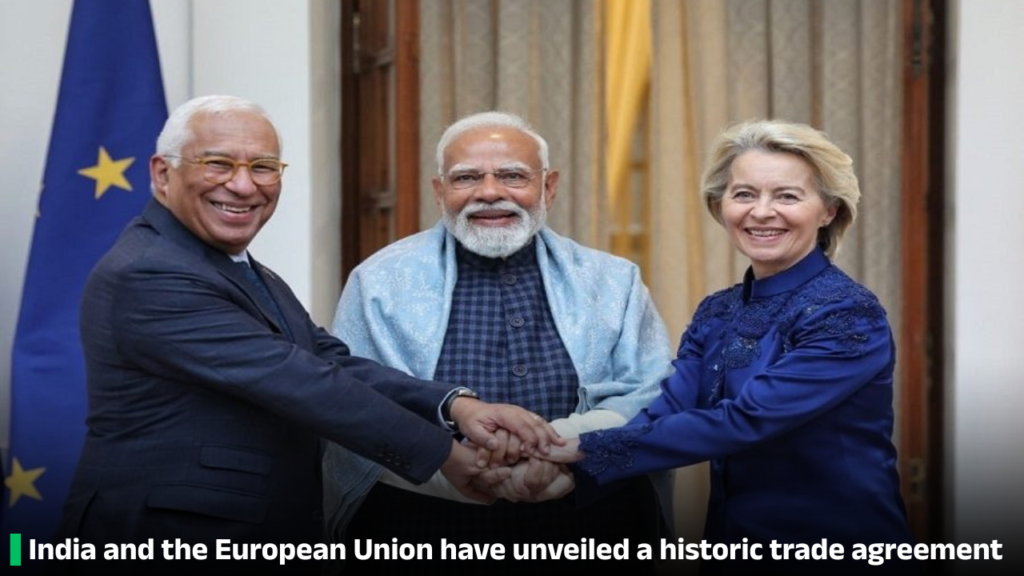
European Commission President Ursula von der Leyen said at a media briefing in Delhi, “We did it; we struck the biggest deal of all the deals.” Indian Prime Minister Narendra Modi called the agreement “historic.”
This will allow for free trade in goods between the 27 European countries and the world’s most populous nation, which together represent approximately 25% of global gross domestic product and a market of two billion people.
The deal includes significant tariff reductions on a wide range of goods and services and a joint security partnership.
Von der Leyen and European Council President Antonio Costa are in Delhi, where they met with Modi at a bilateral summit.
The European Commission said the agreement will gradually eliminate tariffs on most exports of chemicals, machinery, and electrical equipment, as well as aircraft and spacecraft.
Notably, duties on motor vehicles, currently at 110%, will be reduced to 10% under a quota of 250,000 vehicles. According to Bloomberg, this is six times the quota of 37,000 units granted by India to the UK in a deal signed last July.
India will also reduce tariffs on wine, beer, and olive oil from the EU. Brussels said the agreement will support investment flows, improve access to the European market, and deepen supply-chain integration.
Delhi said that almost all of its exports will receive “preferential access” to the EU, with tariffs reduced or eliminated on textiles, leather, marine products, handicrafts, gems, and jewelry.
It states that items such as tea, coffee, spices, and processed foods will benefit from this agreement, but Delhi has “wisely protected sensitive sectors such as dairy, cereals, poultry, soy meal, and certain fruits and vegetables, and balanced export growth with domestic needs.”
Delhi and Brussels have also agreed on a mobility framework, which will reduce restrictions on the travel of professionals between India and the EU in the short term.
Modi said, “This is India’s largest free trade agreement. It will make it easier for Indian farmers and small businesses to access the European market. It will also boost the manufacturing and service sectors. It will foster innovative partnerships.”
This trade deal comes at a time when both India and the EU are facing economic and geopolitical pressure from the United States.
Delhi is still grappling with the 50% tariffs imposed by President Donald Trump last year, while negotiations to finalize a trade deal between India and the US are still ongoing.
Last week, Trump threatened to escalate his trade war with European partners over their opposition to a potential US acquisition of Greenland but later backed down.
The broader geopolitical context was evident in the leaders’ statements.
On Tuesday, von der Leyen said, “This is the story of two major economies—the world’s second and fourth largest economies. Two major economies that have truly chosen partnership in a win-win way. A strong message that cooperation is the best answer to global challenges.”
A day earlier, Costa, without naming the US, said that the trade deal would send “an important political message to the world that India and the EU believe in trade agreements more than tariffs.”
Experts say the deal with the European Union could help labor-intensive sectors in India, such as shrimp farming, textiles, and gems and jewelry, which were severely impacted by US tariffs.
However, some analysts anticipate challenges—especially when it comes to complying with EU regulations and standards. Economist Mitali Nikore says, “EU regulations are very stringent, for example, on the environment. It is one of the leaders when it comes to carbon offsetting mechanisms.” They say that India’s manufacturing sector is “perhaps not fully ready” for this and that it’s crucial to take steps to address this.
“This is more of an opportunity than a challenge,” she says.
For the EU, the deal aims to provide some certainty, even security, during a time of economic pressure and global upheaval.
Andrew Small, Asia Director at the European Council on Foreign Relations, says that Germany and France stand to benefit the most, even if this isn’t the “super-maximally ambitious” version of the trade deal that was once envisioned.
However, he says the agreement is being viewed as a building block rather than a final destination, as the EU seeks to capitalize on a large, rapidly growing economy. “It’s really seen as a foundation for what’s possible in the bilateral relationship.”
The formal signing is expected later this year, once the European Parliament and member states approve the agreement.
There may be some concerns, however, as another major trade deal between the EU and the South American Mercosur bloc recently stalled in the European Parliament.
However, Small says the agreement with India is considered less controversial because it “takes into account the sensitivities of both sides.”
Alongside the trade agreement, India and the European Union are also holding separate talks on security and defense cooperation and climate action.
On Tuesday, India’s Defence Minister Rajnath Singh said he discussed a range of bilateral security and defense issues with European Commission Vice-President Kaja Kallas, including opportunities to integrate supply chains to build a resilient defense ecosystem and develop future-ready capabilities.
The Reuters news agency reported that the two sides are working on a draft security and defense partnership, covering areas such as maritime security, cyber threats, and defense dialogue.
The EU is India’s largest trading partner for goods, with bilateral trade in goods expected to reach $136 billion (£99.4 billion) in 2024-25, nearly doubling in a decade.
Negotiations for the deal began in 2007 but stalled in 2013 due to disagreements over market access and regulatory demands. Talks officially resumed in July 2022.
An EU diplomat told the BBC that Trump’s tariffs proved to be a “useful last-minute push” to move the deal forward. In the past seven months, India has signed major trade agreements with the UK, Oman, and New Zealand, and a pact signed in 2024 with the four-nation European Free Trade Association bloc of Switzerland, Norway, Iceland, and Liechtenstein came into effect last year. It also signed a trade pact with Australia in 2022.