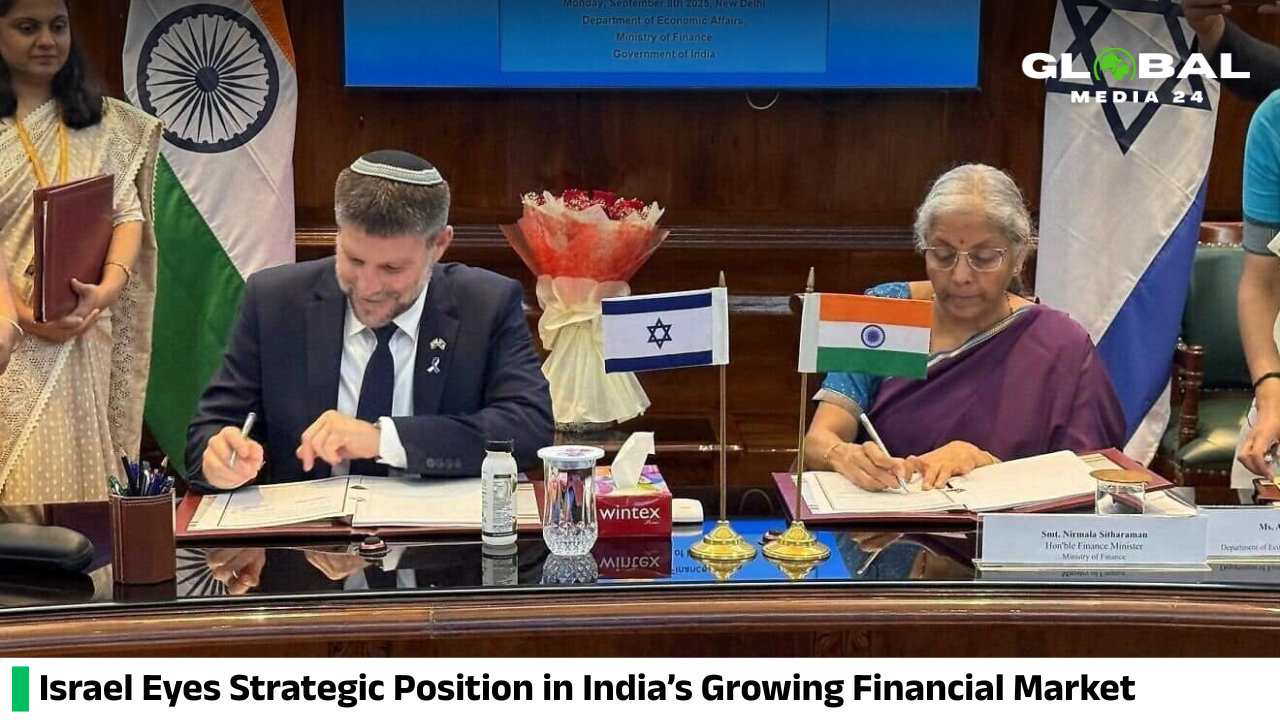
As India moves forward with signing and negotiating trade agreements with the European Union, the United States, and other major economies, Israel recognizes the need to strengthen its economic ties with New Delhi.
Shmuel Abramzon, chief economist at Israel’s Finance Ministry, has said that the relationship between New Delhi and Jerusalem is entering a crucial phase—one that will focus less on symbolism and more on delivery.
This was stated while Prime Minister Narendra Modi was in Israel on his second official visit.
Abramzon described the visit as the “next level” in mutual relations, emphasizing progress on trade, technology, defense cooperation, and the long-stalled Free Trade Agreement (FTA) that both sides want to conclude.
“Israel is very, very happy to welcome Prime Minister Modi to Jerusalem,” Abramzon said. “Prime Minister Modi came here in 2017—that visit set the vision and established the friendship and partnership. Now we are at the implementation stage. It is very, very exciting. We are taking everything to the next level.”
FTA negotiations are progressing, but caution is being exercised regarding the timeline
A key expectation from this visit is the acceleration of the India-Israel Free Trade Agreement, especially given the fluctuating global tariffs and changing supply chains.
With India signing or negotiating trade deals with the European Union, the United States, and several other economies, Israel sees the need to deepen its economic engagement with New Delhi.
“We are very, very eager to sign an FTA,” Abramzon said. “Israel knows it has to act quickly.”
Recalling earlier cooperation, he said, “We saw this with the Bilateral Investment Treaty. I was in Delhi to celebrate that signing. As we speak, a team in India is actually involved in negotiations right now.”
While declining to commit to a firm deadline, Abramzon expressed optimism. “I would be careful about setting a timeline, because these things take time, and it’s not just about Israel—it’s about both sides. But I believe it will happen fairly quickly.”
Technology, AI, and Manufacturing: A Natural Match
Abramzon cited technology—especially artificial intelligence—as a key pillar of future cooperation.
He pointed to Israel’s strong presence at the recent AI Summit in India and the growing trilateral and multilateral frameworks involving the United States.
He said, “We are very excited to collaborate with India in AI.” “Israel has strengths in some parts of the AI value chain, but we don’t have enough people to build it. India has scale. This is truly a wonderful match between our two countries.”
In addition to AI, he identified agriculture, water management, semiconductors, civilian technology, and defense as sectors poised for growth. “India’s manufacturing position is very strong and has potential,” Abramzon said. “Being a small country, Israel would like to combine its technology with the scale that India can offer.”
Defense Cooperation and ‘Strategic Alignment’
Defense remains one of the most sensitive yet central pillars of India-Israel relations, built on decades of quiet but consistent cooperation.
Abramzon acknowledged its importance but did not elaborate on specifics.
Responding to questions about joint production and speculation about systems like Israel’s Iron Dome, he said, “I can’t go into details about defense manufacturing.” “But it’s definitely there. It’s a natural fit.”
He placed the defense relationship in a larger strategic context. “Both India and Israel are peaceful countries and want peace in the region,” Abramzon said. “But part of that is also about being strong in our regions. Both sides understand that, and certainly the defense industry is part of the deal.”
The visit is expected to elevate the relationship between the two countries into an even greater strategic partnership, with Prime Minister Modi invited to deliver a speech in the Knesset, a rare honor that reflects the political warmth between the two democracies.
What Draws Israel to India’s Economy
When asked what is most striking about India’s economy, Abramzon pointed to its growth momentum and institutional innovation, not just its size. “We have seen a very impressive surge that is driving India towards its 2047 vision,” he said. “India is one of the world’s top growers.”
Two areas in particular have drawn Israel’s attention. “The first is the fintech and financial sector,” Abramzon said. “We have seen tremendous growth, and we want to be part of this Indian growth story.”
He expressed Israel’s interest in deeper integration with India’s digital financial infrastructure. “We want to be involved in India’s financial sector. We want to be part of the payment system—the Global Payment System and UPI, which India has developed—and enjoy some of these financial services.”
He emphasized that the second area is manufacturing. “India’s manufacturing capacity is very attractive. Combining Israeli technology with Indian production is a good fit for both sides.”
From Symbolism to Reality
With the tricolor lighting up across Israel and high-level political talks continuing, Abramzon’s message was clear: the India-Israel relationship is maturing.
“Prime Minister Modi’s visit symbolizes continuity, trust, and ambition,” he said. “But more importantly, it demonstrates a shared desire to translate friendship into concrete results.”
As global economic uncertainties reshape trade and technology partnerships, Israel appears eager to further immerse itself in India’s growth story—not only as a partner in innovation, but also as a stakeholder in India’s emergence as a global manufacturing and financial hub.