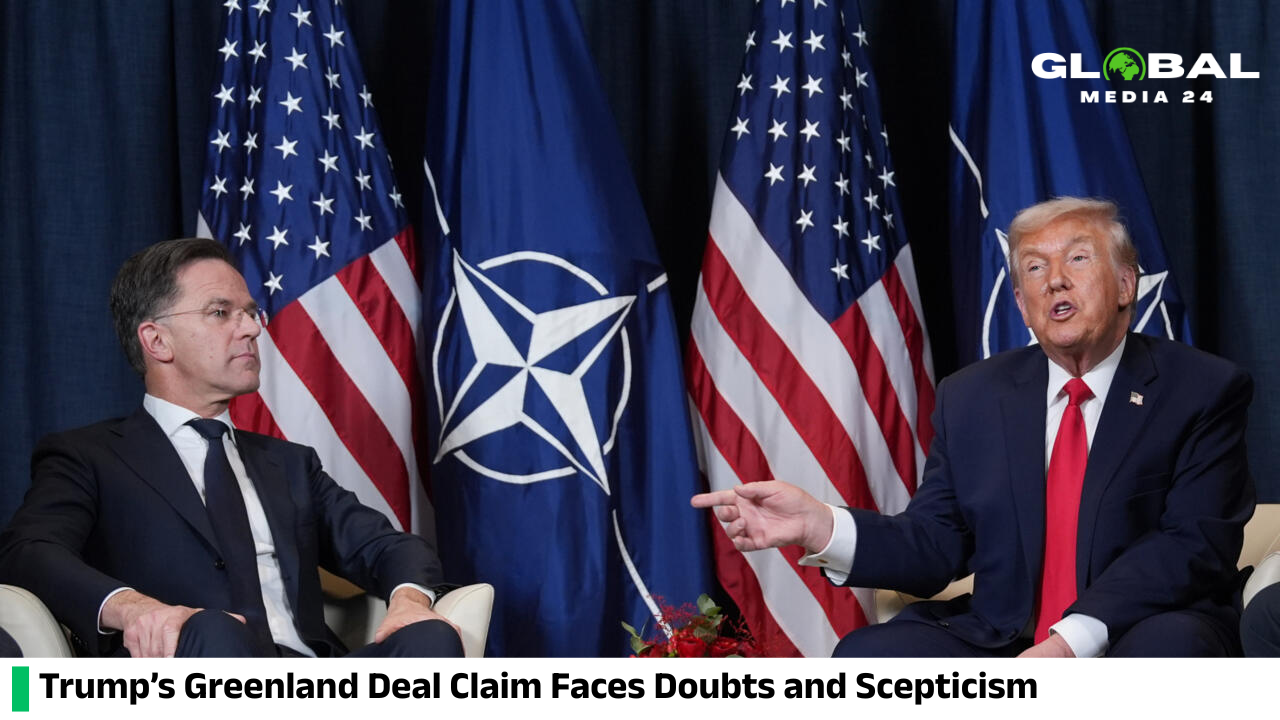
NATO chief Mark Rutte said significant efforts are still required, as several Danish lawmakers raised concerns that Greenland was seemingly left out of discussions with the U.S. president.
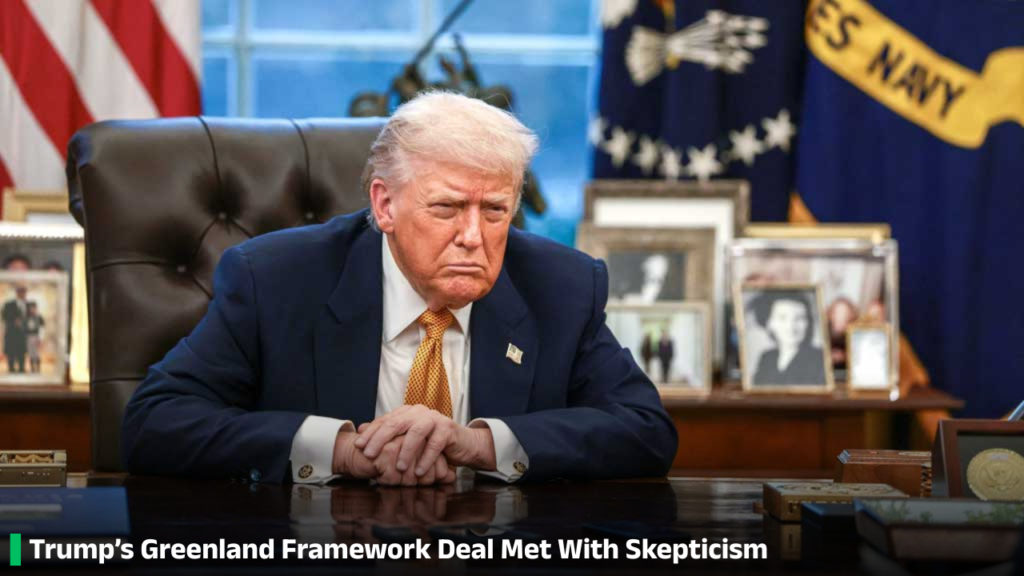
Donald Trump has announced a “framework for a future deal” to resolve the Greenland issue after weeks of escalating threats, but the people of the Arctic territory have expressed deep skepticism, while financial markets rallied and European leaders welcomed the reprieve from further tariffs.
Just hours after the president said in a speech at the World Economic Forum that he wanted Greenland, including “rights, title, and ownership,” but backed away from his more aggressive threats of military intervention—Trump announced on social media a “framework for a future deal regarding Greenland” after talks with NATO Secretary-General Mark Rutte and withdrew his threat of tariffs against eight European countries.
He later called it “a concept for a deal” when speaking to the business network CNBC shortly after Wall Street closed.
“The day ended better than it started,” said Danish Foreign Minister Lars Løkke Rasmussen. “Now, let’s sit down and figure out how we can address American security concerns in the Arctic while respecting Denmark’s red lines.”
Italian Prime Minister Giorgia Meloni also welcomed Trump’s decision, but Rutte, who brokered the deal with Trump on Wednesday, cautioned that “much work remains to be done.”
When asked by Fox News whether Greenland would remain part of the Kingdom of Denmark under the deal, Rutte said the issue had not yet come up, and he offered no further details about the agreement.
NATO spokesperson Alison Hart said the framework Trump was referring to would focus on strengthening Arctic security “through the combined efforts of the allies.”
But some Danish MPs were angry, including Sasha Faxe, who was upset that Greenland was excluded from Wednesday’s talks. He told Sky News, “This isn’t a real negotiation; it’s two men who have had a conversation.” “There can be no deal without Greenland being part of the conversation.”
According to media reports, the agreement would give the US control over small areas of Greenland where military bases are located. Unnamed officials quoted in The Telegraph compared the proposal to the UK military bases in Cyprus, which are considered British territory.
According to The Telegraph, the framework would also likely allow the US to mine for rare earth minerals without permission from Denmark.
It is unclear whether Denmark has signed off on the deal, but on Wednesday night, Aaja Chemnitz Larsen, the Greenlandic member of the Danish Parliament, said that the idea that NATO should have any say over the territory’s sovereignty or minerals was “completely out of the question.”
After days of escalating tensions that signaled the deepest rift in transatlantic relations in decades—and a passionate defense of the rules-based order by Canadian Prime Minister Mark Carney on Tuesday—the reasons for Trump’s retreat remain unclear.
Swedish Foreign Minister Maria Stenergard said that the work of European allies had “had an effect” and reiterated that they would not be “blackmailed.”
Dutch Prime Minister Dick Schoof called Trump’s decision to waive the tariff threat against European allies a sign of “de-escalation,” and EU leaders are now set to discuss their options at an emergency summit in Brussels on Thursday.
Others pointed to volatility in financial markets, as US stock markets saw a sharp sell-off on Tuesday following Trump’s harsher comments on Greenland. Global markets rallied on Wednesday after Trump announced the framework deal and backed down from the tariff threat.
“When he said we wouldn’t use force, the market rallied,” said Mark Hackett, chief market strategist at Nationwide in Boston, while financial analyst Matthew Smart said, “The uncertainty premium is gone.”
Others noted that Trump has a history of making repeated threats and then backing down when financial markets begin to fall.
After he pulled back from his global trade war following a sharp market decline last April, the Financial Times coined the acronym “Taco”—“Trump Always Chickens Out”—to describe the event.
The US publication Semafor reported that Trump appeared frustrated by the market reaction this week and said that his stance against European allies came with too much risk.
“Countries like the UK, Belgium, and France hold trillions of dollars in US assets like Treasuries.” Reporter Eleanor Mueller wrote, “If they decide to sell them, it could send interest rates soaring.”
Michael McFaul, former US ambassador to Russia and a staunch critic of Trump, said the shift in tone was the result of multiple pressures on the president: “A united Europe, the markets, other US politicians, the independent media, and public opinion all combined to stop Trump’s crazy gambit of trying to buy and annex Greenland.”
However, Trump’s announcement about Greenland was met with considerable skepticism. One man in the capital, Nuuk, interviewed by the AFP news agency, said, “He’s lying.”
This sentiment was echoed by care worker Anja, who told AFP, “Greenland belongs to the Greenlanders.”