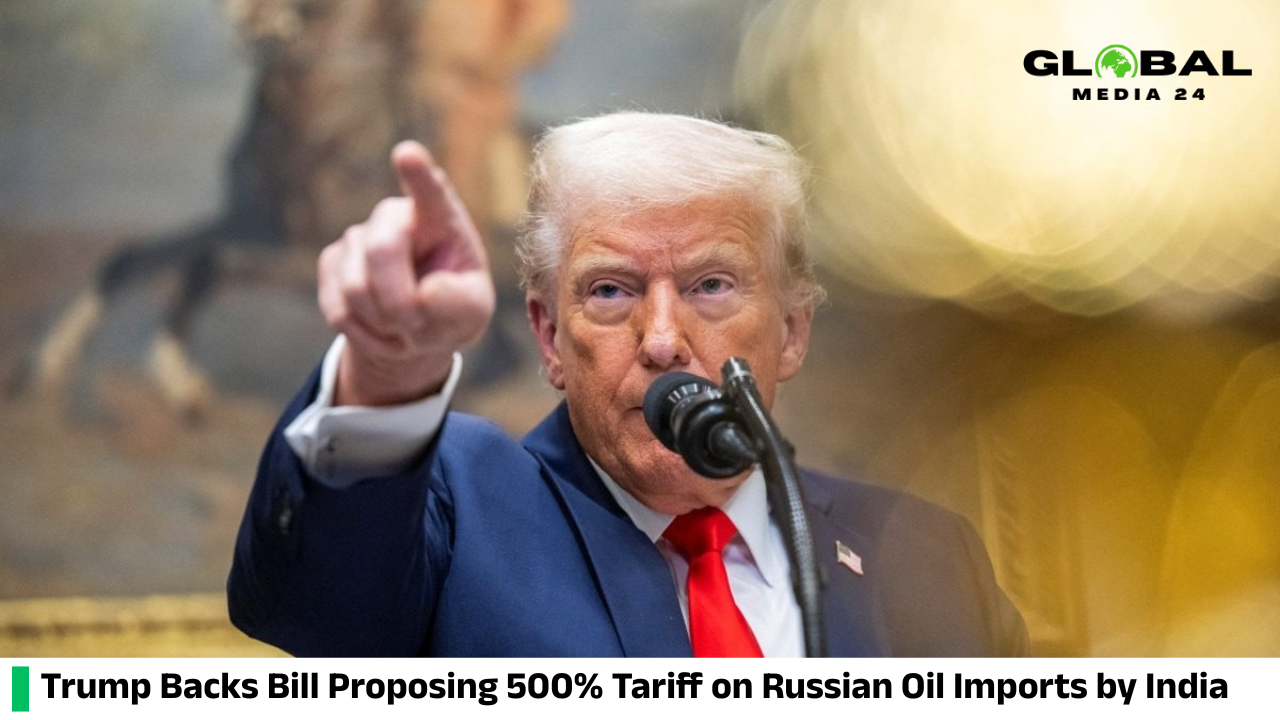
If approved, the Graham-Blumenthal sanctions bill would empower the US president to impose tariffs of up to 500% on countries that knowingly buy Russian oil or uranium, accused of helping finance President Vladimir Putin’s war effort.

US President Donald Trump has given the “green light” to a Russia sanctions bill that could be used to punish Moscow’s trading partners, including India, China, and Brazil, for buying Russian oil, according to Republican Senator Lindsey Graham, a prominent defense hawk.
If the Graham-Blumenthal sanctions bill passes, it would give the US president the authority to impose tariffs of up to 500 percent on countries that knowingly purchase Russian oil or uranium and “fuel Russian President Vladimir Putin’s war machine.”
The tough sanctions package is aimed at weakening Moscow economically as the Trump administration negotiates a deal to end the war sparked by Russia’s invasion of Ukraine.
Graham said he met with Trump at the White House on Wednesday, during which the president endorsed the bill, which has been in the works for months.
A White House official, speaking to The Associated Press, also confirmed the development.
“This will be timely, as Ukraine is making concessions for peace, and Putin is just talking and killing innocent people,” Graham said in a statement.
Graham said a vote could come as early as next week, although it’s unclear how likely that is.
The Senate is scheduled to consider a smaller government funding package next week, which the House is currently considering, if the House passes it. The Senate is also on recess next week for Martin Luther King Jr. Day.
About the Russia Sanctions Bill
This bill, primarily authored by Senator Lindsey Graham and Democratic Senator Richard Blumenthal, would allow the administration to impose tariffs of up to 500 percent and secondary sanctions on countries that purchase oil, gas, uranium, and other exports from Russia.
The goal is to cut off the source of financing for most of Russia’s military operations.
The White House had previously pushed for some modifications and flexibility in the sanctions package for Trump, but it’s unclear whether any changes were ultimately agreed upon.
The legislation has dozens of co-sponsors in the Senate, as well as a companion bill in the House, drafted by Republican Representative Brian Fitzpatrick.
The Trump administration is currently attempting to finalize a peace deal to end the nearly four-year-old conflict in Ukraine, with special envoy Steve Witkoff and Trump’s son-in-law Jared Kushner serving as the U.S. president’s chief negotiators.